Search

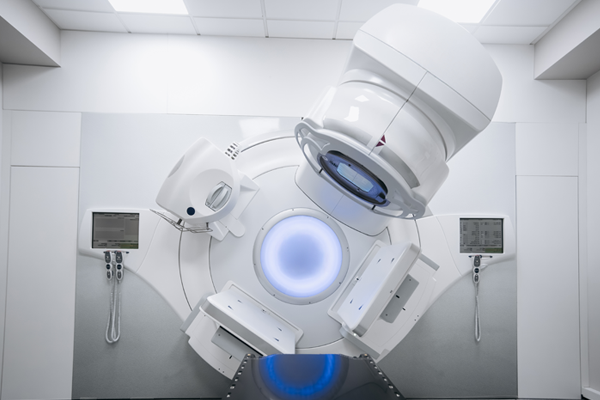
Radiation therapy involves the precise use of high energy X-rays to treat cancer safely and effectively. Radiation oncologists are cancer doctors who use radiation to cure cancer, control cancer growth or relieve symptoms, such as pain or bleeding. In most cases, photon (X-ray based) therapy is used to treat cancer and can deliver high doses of radiation therapy to the cancer while sparing nearby healthy organs.
Radiation works by damaging the DNA of cancer cells so the cancer is unable to grow. When these cells die, the body naturally eliminates them from your body. Healthy cells can also be affected by radiation, but these normal cells can repair themselves in ways that cancer cells cannot.
Radiation therapy equipment and technology have continuously been improving and evolving to make treatments more effective for you, while minimizing possible side effects.
Systemic therapy, including chemotherapy and immunotherapy, is also an important treatment to destroy cancer cells and improve cure rates. Immunotherapy is a cancer treatment that helps your immune system fight cancer and may be useful for some patients. More commonly, medical oncologists will prescribe chemotherapy or other targeted agents that attack specific cancer cells and reduce the risk of cancer spreading in the body. The doses may be given daily, weekly or every few weeks and can be given in pill form or injections that are delivered directly into veins (IV). If you need systemic therapy, your medical oncologist will discuss its use before, during or after the course of radiation therapy.
Surgery can be used to treat cancers in the colon, rectal and anal areas. The need for surgery and type of surgery that are required can be very different depending on the type of cancer, the location of the cancer and the cancer’s response to other treatments, including chemotherapy and radiation.
Talk with your doctor about which type of treatment is best for you and your cancer.
External beam radiation therapy involves a series of daily treatments that accurately deliver radiation to the area needing treatment. The radiation beam usually comes from a machine called a linear accelerator. Before beginning treatment, you will be scheduled for a session to map out the area to be treated. This will frequently involve having a CT scan. Landmarks placed on your skin (often tiny tattoos) allow the radiation therapists delivering your treatments to position you in the same position each day.
To minimize side effects, the treatments are usually spread out over several weeks, five days a week (Monday through Friday). This allows your doctors to get enough radiation into your body to kill the tumor cells, while giving healthy cells time to recover each day.
Technical terms that may be mentioned for colorectal and anal cancer treatments include three dimensional conformal radiation therapy (3-D CRT), intensity modulated radiation therapy (IMRT) and image guided radiation therapy (IGRT). Your radiation oncologist can provide more information about these different techniques.