Search

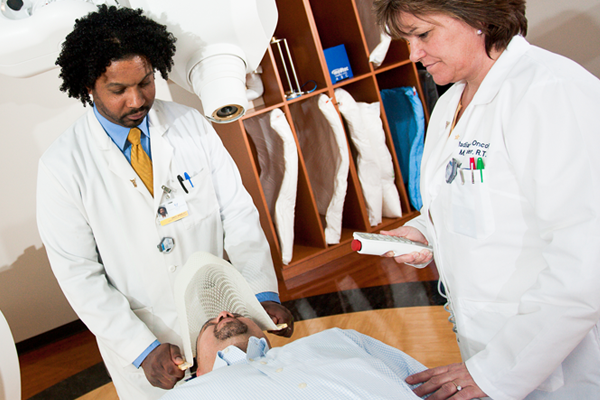
Radiation therapy involves delivering focused radiation to treat cancer cells by destroying their ability to multiply. Surrounding healthy tissue is also affected by radiation and may have some damage. However, healthy normal cells are better able to heal from radiation injury, compared to cancer cells, because they have maintained the ability to repair radiation-induced damage.
For head and neck cancers, radiation often allows organ-sparing treatment that can give patients equal cure rates with better swallowing and/or voice function with equal cure rates as compared to surgically removing a tumor. In some cases, radiation will be combined with surgery, chemotherapy or both.
Surgery is an important curative approach to treatment. From biopsy to evaluating the nose, mouth and throat with a flexible endoscopic camera, your surgeon can fully assess whether the tumor has spread. If surgery will be part of your treatment, your surgeon can remove the tumor with a rim of normal tissue. Depending upon the tumor location and how advanced it is, the surgeon may also surgically remove lymph nodes in the neck. The lymph nodes, part of the normal immune system, are a common path for spread in some tumors. Ask your doctors the likelihood of the lymph nodes being involved and whether you need surgery or radiation for the lymph nodes in the neck.
In some cases, surgery is combined with radiation. If radiation is the main treatment, some surgery may be helpful afterwards but is determined on a case-by-case basis. If surgery is the main treatment, radiation may be helpful after surgery if more advanced disease is found.
While surgery and radiation focus directly on treating the tumor, medication is often recommended to improve cure rates. A medical oncologist will evaluate you and determine what medications may be most helpful in accomplishing those goals. Two of the main categories of systemic therapy (treatment that is injected into a person's blood system) are:
Ask your medical oncologist whether these drugs may be helpful for you.
Dental care is an essential part of preparing for treatment. Ask your doctor whether or not you need to see your dentist before starting treatment.
If you have teeth, before you begin head and neck radiation therapy you will need to be examined by a dentist or oral surgeon for a pre-radiation dental evaluation. As your mouth becomes dry following the treatments, you may be at risk for increased cavities. Therefore the dentist will make fluoride carriers for your teeth to use on a daily basis.
If the dentist determines that you need any dental procedures or if you need bad teeth removed, this must to be done prior to initiating radiation therapy because your jaw bone does not heal as well following radiation therapy. It is important to be aware that this may delay starting radiation treatment for up to two weeks to allow time for healing.
Radiation therapy treatments are delivered in a series of painless daily sessions. Treatments are usually scheduled daily, Monday through Friday, for five to seven weeks. In some cases, your radiation oncologist may schedule your radiation treatments to be twice a day, with several hours between treatments.
Before beginning treatment, you will be scheduled for a planning session to map out the area your radiation oncologist wishes to treat. This procedure is called a simulation. Simulation involves having X-rays and/or a CT scan. To help you keep still during treatment, your doctor may use a plastic mask over your head and shoulders. You can see and breathe through this form-fitting device which is made to comfortably make sure movement during treatment is minimized. In some cases, other devices may help make sure the radiation to normal parts of the mouth are avoided.
You may also receive tiny marks on your skin, like a permanent tattoo, to help the radiation therapist precisely position you for daily treatment. Sometimes, these marks can be made on the plastic mask so there are no permanent marks on your skin. Ask your radiation oncologist whether you will need any tattoos as part of your simulation.
Also called brachytherapy, this treatment involves inserting radioactive material into a tumor or surrounding tissue to give a more focused dose of radiation. For head and neck cancers, brachytherapy is often used with external beam radiation therapy, but it may also be used alone or given after surgery.
During brachytherapy, your radiation oncologist places thin, hollow, plastic tubes into the tumor and surrounding tissue. These tubes are loaded with tiny radioactive seeds that remain in place for a short time to kill the cancer. The seeds and the tubes are then removed. With low-dose-rate brachytherapy, the seeds will be left in place for one to three days. For high-dose-rate brachytherapy, a single radioactive seed stops at various positions along the tubes for short times to deliver an equivalent dose and is usually given in a few sessions over two or more days. The exact type of brachytherapy and lengths of time the seeds are in place will depend on your cancer and treatment plan.