Search
Tafadzwa L. Chaunzwa, MD, MHS, shares how a grant from the Foundation was a catalyst for his career as a physician scientist working to transform cancer care through AI.
Dr. Tafadzwa Chaunzwa's research at the intersection of artificial intelligence (AI), imaging, and radiation oncology is shaping new ways to understand and treat lung cancer. He leads the Advanced Computing and Oncology (ACO) Lab at Memorial Sloan Kettering Cancer Center (MSK), where he is a physician-scientist focused on treating lung cancer and related thoracic malignancies. When Dr. Chaunzwa was an ABR Holman resident at the Harvard Radiation Oncology Program, he received the James D. Cox Research Award from ASTRO’s foundation, then known as the Radiation Oncology Institute (ROI), to support his work applying AI-enabled quantitative imaging to personalize radiotherapy in the immunotherapy era and characterize radiotherapy-driven immune modulation in lung cancer. His journey illustrates how investments in early career researchers at pivotal moments can have lasting and significant impacts for both the individuals and the broader field.
Dr. Chaunzwa’s background in mathematics, biomedical engineering and data science led him to focus his research during medical school and residency on medical image analysis to extract features that can inform practice. With the grant from ROI, Dr. Chaunzwa led a project using quantitative imaging and foundation models to analyze CT scans in patients with non-small cell lung cancer to identify signatures that help predict their response to immunotherapy and radiotherapy. Foundation models are trained on large image datasets and then fine tuned for narrower clinical tasks, such as predicting tumor biology or characterizing host features including body composition. “It’s really a scalable and more efficient way of feature extraction,” Dr. Chaunzwa explained.
Dr. Chaunzwa and his team combined the image analysis with clinical and demographic risk factors to develop frameworks that can predict response to immunotherapy and personalize radiotherapy. Selected results from this work were published in JAMA Oncology1 (June 2024) in the article “Body Composition in Advanced Non–Small Cell Lung Cancer Treated With Immunotherapy,” with additional findings on self-supervised learning for prognostication in this population presented at the 2023 World Conference on Lung Cancer.2
Although components of his research pipeline remain in active development, others are moving toward clinical translation. MSK’s strong infrastructure for tumor molecular profiling and investigator initiated trials has positioned the ACO Lab’s work for prospective validation — one of the most crucial steps toward making AI based tools available in real world practice. “We’re just excited to get our work out into the public domain,” Dr. Chaunzwa noted, emphasizing the importance of rigorous validation in advancing innovations toward regulatory approval.
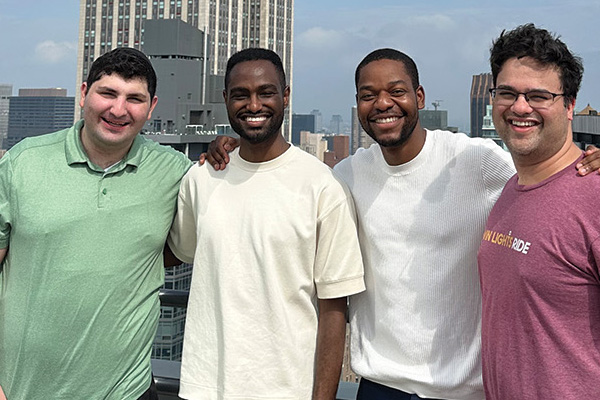
For Dr. Chaunzwa, the grant he received from ROI marked an essential turning point. It was the first time he secured extramural funding as a principal investigator, which he described as a key milestone in his career. The Foundation’s investment allowed him to begin charting an independent scientific path, including hiring his first research assistant and purchasing equipment for research. Just as importantly, it prepared him to compete successfully for additional awards and grants from other organizations and the National Cancer Institute. He also laid the groundwork for establishing the ACO Lab, now 12 members strong, bringing together individuals from a broad range of academic and personal backgrounds. Dr. Chaunzwa shared, “One of my greatest aspirations is to be a thoughtful and supportive mentor as the members of my team chart their own paths. Their growth and contributions are central to everything we do.”
Ultimately, the purpose of the team’s research is deeply patient centered. Understanding treatment sensitivity, predicting side effects, and identifying meaningful patterns in imaging all support a future in which lung cancer care is more personalized and effective. “This grant was a major catalyst for my research career. It gave me the chance to lead my own work, build a team, and accelerate discoveries that I hope will improve outcomes for people with lung cancer,” said Dr. Chaunzwa.